What you will learn
- Identify the payout mechanic before counting reels.
- Clusters depend on adjacency; pays-anywhere rules differ.
- A larger ways count does not establish a better return.
Paylines depend on positions
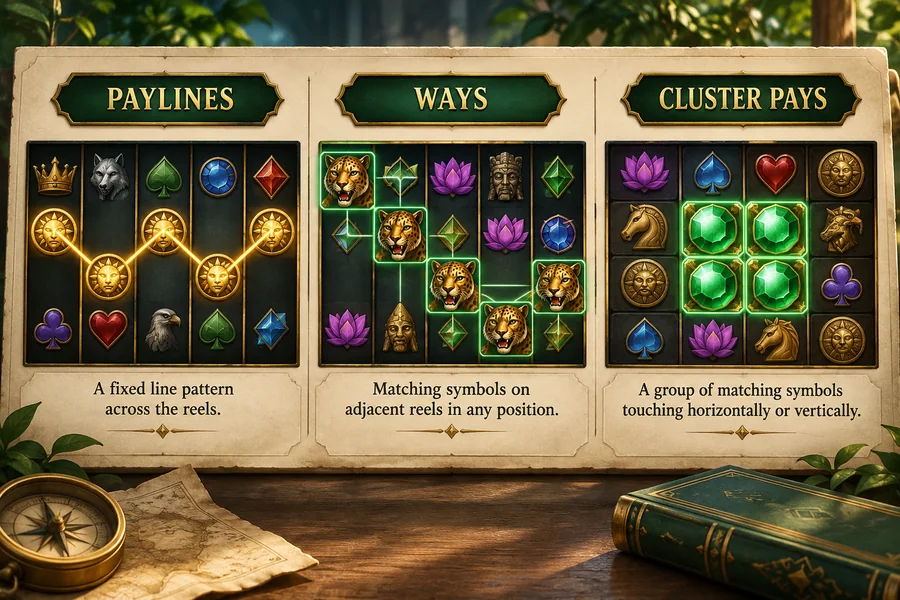
Paylines are set paths through the reels. Matching symbols must fall along a counted path and follow the game’s direction rules. The original The Dog House has twenty lines; Wild Chapo has fifteen fixed lines. The paytable shows which positions count.
Ways evaluate combinations across reels
Mahjong Ways uses 1,024 ways, while Lucky Neko lists a changing range from 2,025 to 32,400. These numbers describe combinations considered by the rules, not promised wins. Symbol values and other conditions still matter.
Clusters and pays-anywhere are not synonyms
Sugar Rush uses adjacent groups of at least five matching symbols. Gates of Olympus uses at least eight matching symbols without that adjacency requirement. Both can involve tumbles, but a tumble describes replacement after a payout rather than defining the payout mechanic.
- Check whether combinations must begin on the left.
- Check whether diagonal adjacency counts.
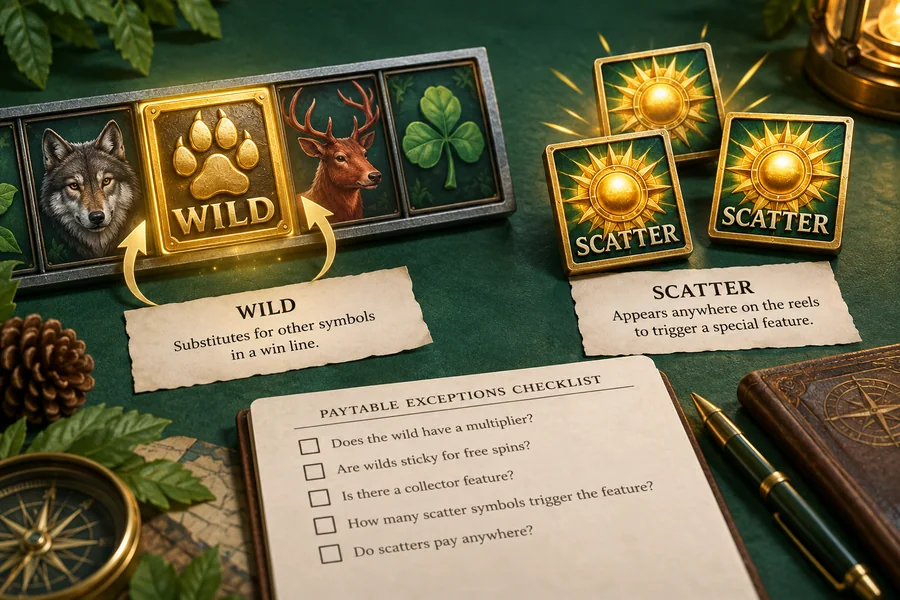
- Read scatter and wild exceptions separately.
Mahjong Ways versus Mahjong Ways 2: what changes
PG Soft describes the original as five reels with four rows each. The sequel adds a row on reels two, three and four, giving a 4–5–5–5–4 layout. Multiplying the positions gives 4⁵ = 1,024 and 4 × 5 × 5 × 5 × 4 = 2,000 ways. These counts describe positional combinations, not winning combinations that must occur in a round.
Both editions have wild transformations and free-spin multipliers. The sequel additionally describes ordinary symbols on reel three becoming gold during free spins, excluding wilds and scatters; gold symbols involved in a win transform into wilds. Check the sequence in the actual edition’s Help screen rather than borrowing the other edition’s rules.
| Comparison | Mahjong Ways | Mahjong Ways 2 |
|---|---|---|
| Reels and rows | 5 reels · 4–4–4–4–4 | 5 reels · 4–5–5–5–4 |
| Ways count | 4⁵ = 1,024 | 4 × 5 × 5 × 5 × 4 = 2,000 |
| Provider catalogue RTP | 96.92% · confirm the in-game setting | 96.95% · confirm the in-game setting |
| Highest free-spin multiplier described | Up to ×10 | Up to ×10 |
| What these numbers cannot establish | Per-round win probability or short-session profit | Per-round win probability or short-session profit |
Why 2,000 ways does not establish easier wins
Increasing ways from 1,024 to 2,000 does not increase win probability in the same proportion: symbol probabilities, payouts and features belong to each game’s mathematical model. A 96.92% versus 96.95% RTP gap is 0.03 percentage points. At 10,000 hypothetical units of cumulative stakes, the expected payout difference is three units: 10,000 × 0.0003 = 3. This is neither a 10,000-round test nor a recommendation for either edition.
- Match the edition and its Help-screen RTP.
- Read wild and scatter exceptions before comparing features.
- Separate reel counts from payout rules: The Dog House uses lines, Sugar Rush adjacent groups, and Gates of Olympus symbol counts.
Frequently asked questions
Does tumble mean cluster pays?
No. Tumble describes symbol replacement; the payout rules must be read separately.
Does Mahjong Ways 2 win more often because it has more ways?
Ways count alone cannot establish that. Comparable probabilities and a consistent definition of a hit are needed; positional counts and RTP do not give the game’s hit frequency.
Sources
Last checked 10 October 2026